
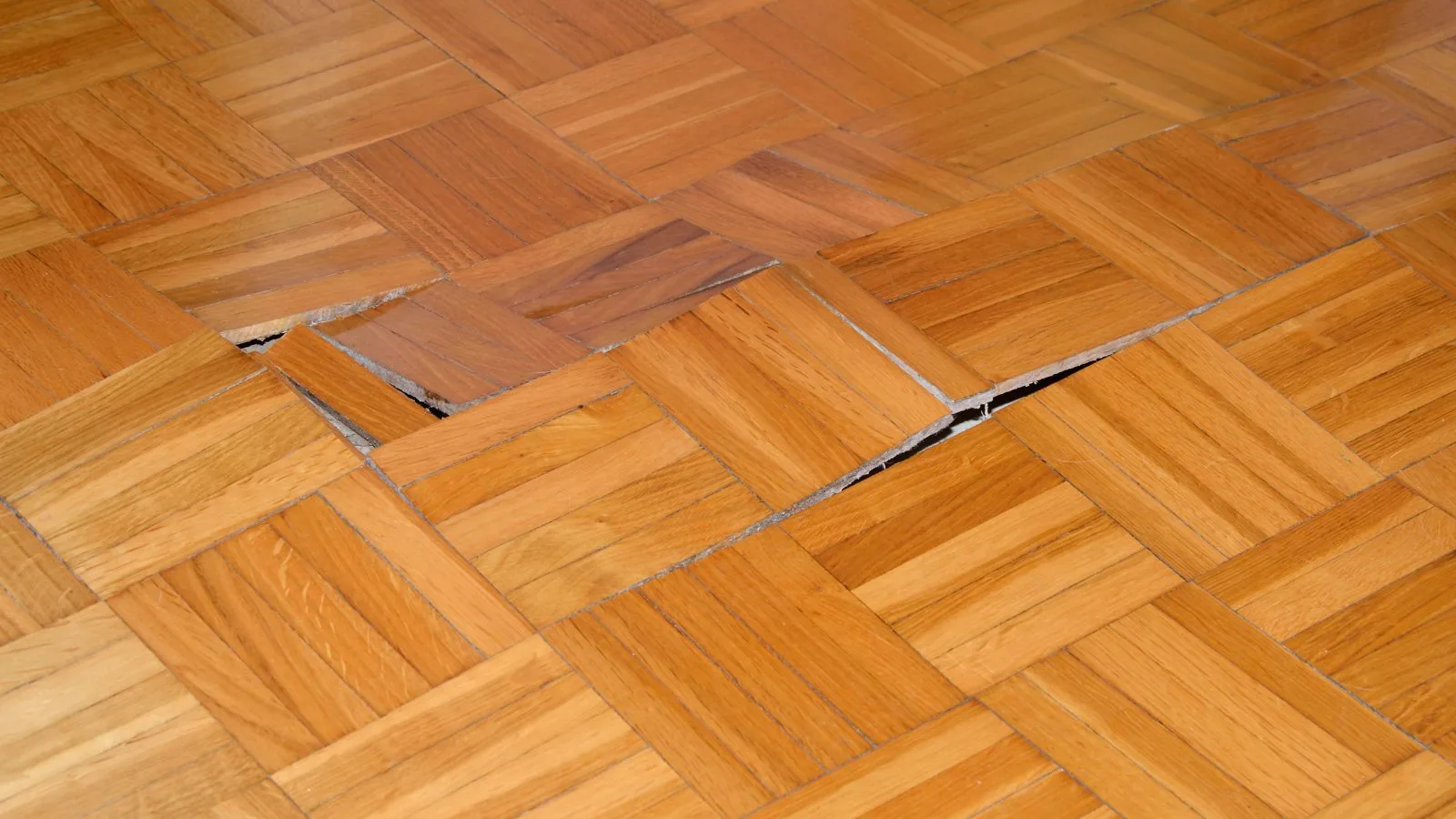
Wood takes on water from the bottom, and the boards swell unevenly. Hardwood floor water damage repair in Pequannock starts with drying, because boards that cup in the first days often flatten again as they reach a normal moisture level. Sanding or replacement comes after, and only if the floor does not recover.
Wipe up standing water, lift area rugs and furniture legs off the wood and call. Do not run heat or a hair dryer on the boards, since drying too fast can split them.
Why boards cup and buckle
Water enters at the seams and the underside. The bottom of each board swells faster than the top, so the edges rise and the board cups. If the swelling is strong and the floor is nailed down, whole sections can lift off the subfloor, which is called buckling.
Solid, engineered and laminate floors
| Floor type | How it reacts | Typical outcome |
|---|---|---|
| Solid hardwood | Swells, cups, may crown after drying | Often saved if dried promptly |
| Engineered wood | Layers can separate and edges lift | Depends on the wear layer and the glue |
| Laminate | Core swells and does not recover | Usually replaced |
What to do before help arrives
- Do not walk on boards that are lifting, since they can crack or move.
- Do not run a heater at the floor or cover it with plastic.
- Lift rugs and furniture legs off wet wood and photograph the floor.
How a floor is dried
- Moisture readings are taken across the floor and the subfloor.
- Wet pad or underlayment, if present, is removed.
- A floor drying system, with panels or mats, pulls water out through the boards while dehumidifiers control the air.
- Readings are logged until the boards return to the dry standard, then the floor is checked for flatness.
When replacement is the better call
If boards are still cupped or lifted after drying, or if the finish has turned black from mold, sanding will not fix it. In that case damaged boards are removed and replaced, and a refinishing contractor blends the finish. We tell you what the readings show before any boards are pulled.
What the first 48 hours look like
In the first day, boards on the wet side take on water and begin to swell. Cupping, where the edges rise above the center, shows up as the moisture moves up through the board. If the floor stays wet, crowning can follow after drying when the center of the board rises above the edges because the surface dried faster than the underside.
Boards that are sealed on top but open at the seams and the underside take longer to give up water than you might expect. Surface fans alone move little water from the bottom of a board, which is why controlled drying through the floor is used.
Things that make it worse
- Covering the floor with plastic or rugs, which traps moisture.
- Using high heat or a heat gun to speed drying.
- Sanding or refinishing before readings are at a dry level.
- Walking on wet boards, which can push them out of line.
- Waiting to see if the floor flattens by itself, since it often does not.
What to ask about your floor
Ask how thick the wear layer is if you have engineered wood, since it decides whether it can be sanded. Ask whether the subfloor is plywood or plank and whether there is a vapor barrier. These details guide whether the floor can be saved, and they help the restoration crew plan the drying.
What affects the cost
| Factor | Why it matters |
|---|---|
| Square footage wet | Drying systems scale with floor area |
| Time before drying began | Early drying saves more boards |
| Floor type | Solid wood saves more often than engineered |
| Subfloor condition | A wet subfloor needs longer drying |
| Refinishing or replacement | Sanding and finishing are separate trades |
Call (833) 521-1033. Scope and price are explained before work starts.
Insurance notes
Keep photos of the floor before and after drying, and the moisture readings. Ask your insurer whether it covers refinishing or replacement if boards do not recover. For the equipment side, see structural drying and dehumidification.
Hardwood floor wet
Lift rugs and furniture legs off the wood and call. Tell the dispatcher how long it has been wet. Scope and price are explained before work starts.
Questions about hardwood floor water damage in Pequannock
Will cupped boards go flat again?
Often, if they are dried in a controlled way. Some stay uneven and need sanding or replacement.
Should I turn up the heat to dry the floor?
No. Fast heat can split boards. Controlled drying works better.
Can you refinish the floor?
We dry it and tell you what readings show. Sanding and refinishing are done by a flooring contractor after drying.
Serving Pequannock and nearby towns
Hardwood calls come from Pequannock, Pompton Plains, Riverdale, Lincoln Park and Pompton Lakes. Wet carpet over the same floor is handled under carpet water damage restoration.